
How Scale Changes Behavior: FCC Regenerators
An introduction to scale effects in Fluid Catalytic Cracking regenerators, followed by an interactive cellular automata demonstration. Explore how identical operating conditions produce different behavior at different scales.
Understanding Fluidized Catalytic Cracking
The Fluidized Catalytic Cracker (FCC) is one of the most important process units in refineries. It breaks down large hydrocarbon molecules (Hhdrocarbons—molecules made of hydrogen and carbon atoms) from heavy crude oil into smaller, more valuable molecules like those used in gasoline blending components.
The process uses a fine powder catalyst—a material that accelerates chemical reactions without being consumed—that circulates continuously through the system and acts as a heat carrier in the process.
How the FCC Works
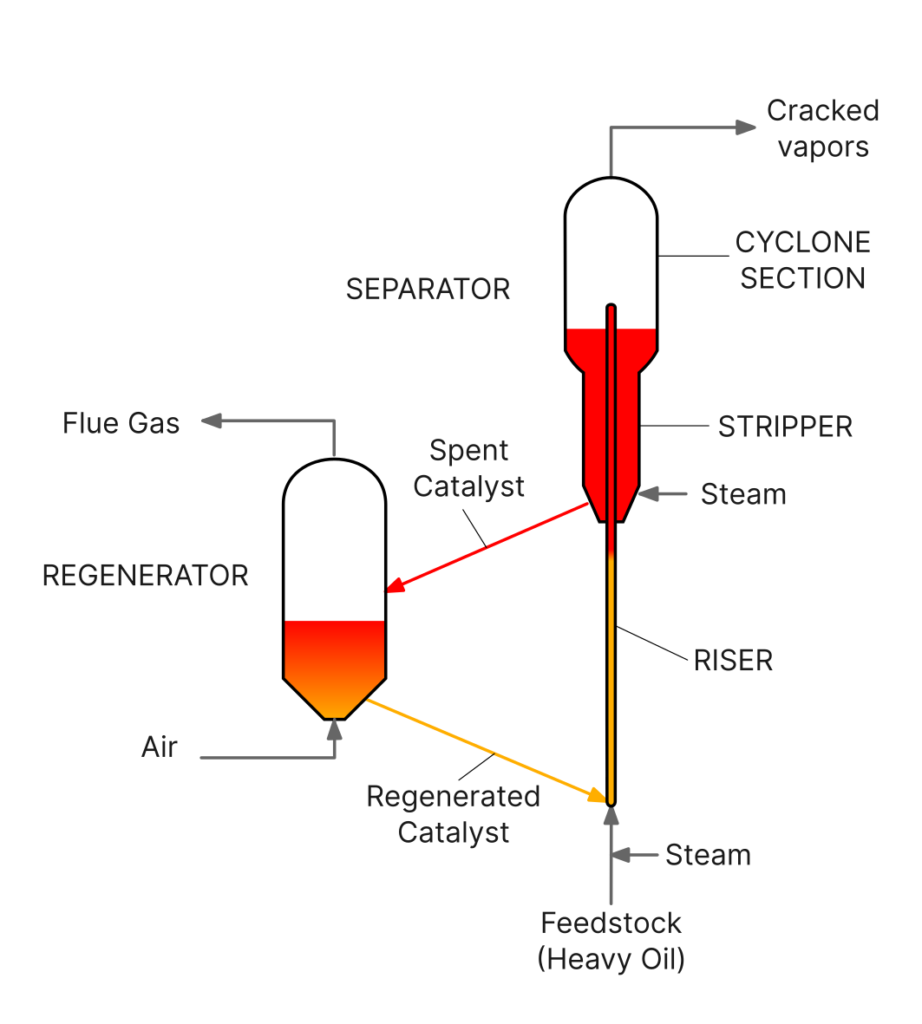
The FCC operates on a continuous catalyst circulation cycle:
In the riser, heavy oil feedstock mixed with steam contacts powder-like catalyst particles at high temperatures (around 500-550°C). This endothermic reaction (requiring heat input) cracks the large molecules into lighter hydrocarbons. During cracking, carbon deposits accumulate on the catalyst particles—a process called “coking.” The mixture discharges into the separator (or disengager) where cyclones separate the cracked hydrocarbon vapors from the catalyst particles. The vapors rise and exit to downstream processing. The spent catalyst passes through a steam stripper, where remaining hydrocarbons are removed, and settles to the bottom.
The spent catalyst flows from the separator to the regenerator. Here, preheated air burns off the carbon in an exothermic reaction (generating heat), resulting in typical regenerator temperature range of around 590–675°C. The regenerated, hot catalyst returns to the riser, providing the heat needed for cracking. This heat cycle is the engine that drives the entire FCC process.
To maintain fluid-like flow, the powder catalyst must remain uniformly aerated—constantly suspended by injected air in the regenerator and steam in the riser.
The Regenerator Challenge
For smooth operation, the regenerator must maintain uniform aeration to:
- Provide oxygen for complete carbon combustion
- Maintain proper catalyst fluidization and avoid localized flow disruptions
- Keep temperatures within safe operating limits
This is relatively straightforward in small pilot-scale units. However, in industrial-scale regenerators—vessels several stories tall handling hundreds of tons of catalyst per hour—achieving uniform conditions becomes dramatically more difficult.
Non-uniform aeration and temperature gradients trigger a cascade of operational problems: maldistribution of air and catalyst flow, localized hot spots, and poor gas–solid contact. These effects are not isolated—conditions in one region influence neighboring zones, reinforcing non-uniformities. In severe cases, this can escalate to loss of proper fluidization, disrupting catalyst circulation and forcing emergency shutdown. Depending on severity, such events can require extended shutdowns with costs ranging from millions to tens of millions of dollars in lost production, catalyst replacement, and equipment repairs.
Why Scale Changes Everything
Two fundamental factors make large-scale regenerators behave differently from pilot units, even under identical operating conditions:
More particle interactions: A commercial regenerator operates at a much larger scale than a pilot unit, with orders of magnitude more catalyst particles. Each particle interacts locally with its neighbors. As system scale increases, these local interactions compound—oxygen availability and heat release become increasingly uneven across the system. A local disturbance (such as a hot spot or uneven air flow) has many more pathways to propagate in a larger system. What remains localized in a pilot unit can spread, interact with other regions, and escalate across a commercial regenerator.
Less efficient heat removal: Smaller vessels have higher surface-area-to-volume ratios. Heat escapes more easily, and local hot spots cool down naturally. Large vessels trap heat internally. Once a region overheats, recovery is much harder—the surrounding mass of hot catalyst sustains the disturbance
About This Simulation
This demonstration uses a highly simplified cellular automata model to illustrate these scale effects. This simulation was presented as part of a technical talk at the Asian Downstream Summit (ADS) 2025 conference. Each cell represents a catalyst particle region that interacts only with its immediate neighbors—exchanging heat and influencing local state (e.g., hot zones or locally intensified regions).
Even though the simulation uses the same rules and operating conditions for both scales, the larger system can exhibit persistent patterns and failure modes that are far less likely, less stable, or absent in the smaller one under the same nominal rules. This is emergence: new patterns and failure modes arising purely from system size, not from different chemistry or physics.
The simulation is conceptual. It is not a predictive FCC unit model and should not be interpreted as representing actual catalyst-particle physics one-to-one. Industrial FCC models incorporate detailed process kinetics, hydrodynamics, heat transfer equations, and validated operational data. This simplified demonstration isolates a different principle: how identical local interaction rules can produce qualitatively different global behavior as system scale increases.
Connecting to Behavioral Complexity
This simulation demonstrates one of several key mechanisms that can drive behavioral complexity in industrial systems—the topic explored in depth in the forthcoming book Beyond the Hype — Complexity, the Overlooked Constraint on Industrial Digitalization.
When operating closer to constraint boundaries with tighter margins, interactions between process elements become more consequential. What worked predictably at pilot scale can exhibit fundamentally different behavior at commercial scale—not because the chemistry or physics changed, but because the system structure changed.
This is behavioral complexity: emergent patterns arising from interaction dynamics, not just complicated physics. Scale is one pathway. The book examines all major mechanisms.
What the Parameters Mean
Adjustable controls (sliders):
- System Disturbance: Random variations in feed composition, air distribution patterns, or operating conditions that the system must handle
- Operating Margin: The control buffer against local escalation (100% = optimal conditions with full safety margin; lower values = tighter constraints, less room for error)
- Initial Variation: Heterogeneity at startup—uneven temperature distribution or catalyst composition before reaching steady state
Scale-dependent factors (editable but typically kept at defaults):
- Scale Factor (pilot: 0.85, commercial: 1.15): Represents how easily disturbances propagate between neighboring regions. In larger regenerators, disturbances spread more readily because there are more interaction pathways. The higher commercial-scale value (1.15) increases transition sensitivity, representing the greater likelihood of disturbance propagation in larger systems.
- Cooling Factor (pilot: 1.02, commercial: 0.95): Represents the efficiency of heat dissipation. Smaller units cool more effectively due to higher surface-area-to-volume ratios (1.02 = slightly enhanced cooling). Larger units trap heat internally (0.95 = reduced cooling efficiency), making recovery from hot zones more difficult.
How the simulation works:
Start with low disturbance and high operating margin—both systems remain stable. Gradually increase disturbance or reduce margin. Watch as the commercial-scale system (right) begins forming persistent hot zones and patterns that are far less likely to emerge in the pilot-scale system.
This is the challenge of industrial-scale complex systems: small-scale tests may not reveal all behaviorally relevant interaction patterns that appear at commercial scale.